2016 in Books

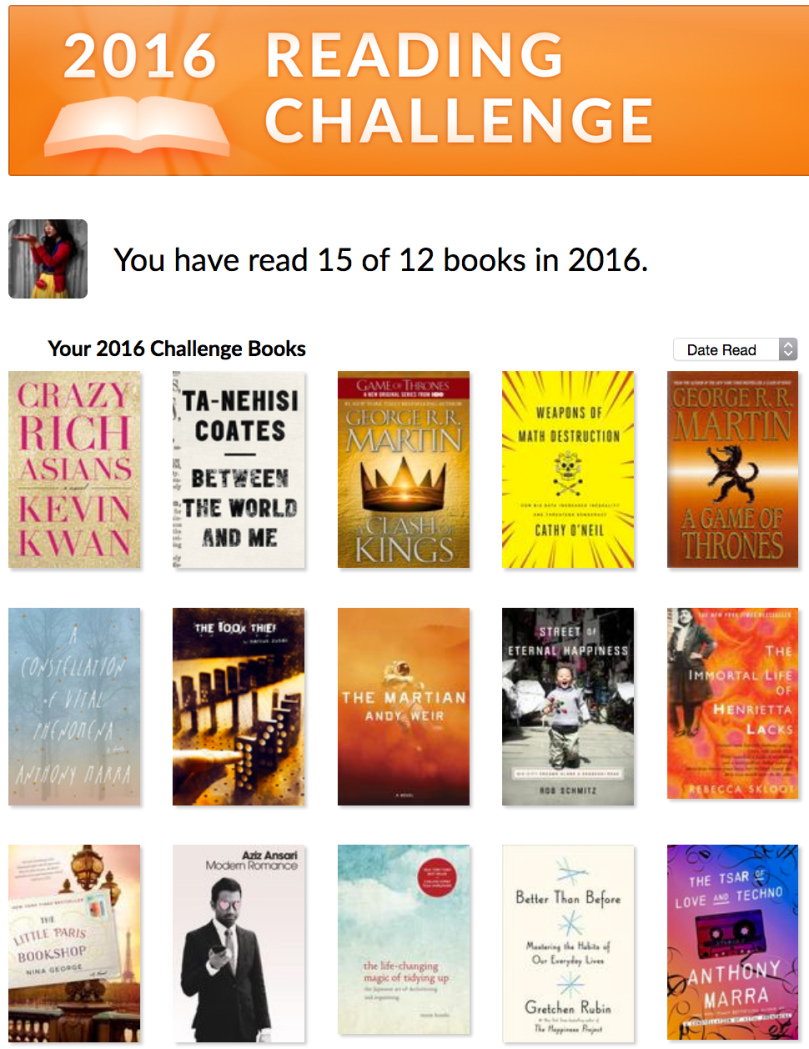
Last year was one of the first years I managed to keep my meager reading resolution! I had to face the hard truth and be realistic with my goal of one book per month, which was very achievable given that I either didn’t read at all in a month or would go on a streak and read many books.

One of the biggest challenges was dedicated reading time. As I mentioned in my 2016 resolutions post, dedicated reading time is key to achieving a certain quantity of books read. For most of my post-grade school life, my dedicated reading time has been on my commute. This meant a lot of reading during my painful 2-hours-each-way days, but not as much reading at my significantly more comfortable 20-minutes-door-to-door job. I also have been reading less on my morning commute, specifically, since we got an Express hawker at my metro stop, which means I will opt to read that morning’s paper instead of my book in the morning. Before committing to reading, I would read the paper in the morning and do the crossword and/or Sudoku puzzles in the afternoon. Now, I try to just read as much as I can in the morning, and then recycle the paper as soon as I get off the train. (I miss my puzzles, though.)

As listed in my 2017 resolutions post, here are some contributing factors for how I was able to achieve my modest reading goal this year:

  1. The Blogging for Books program gave me fresh reading material and motivation to complete books so I could review them.
  2. I invested in an eReader, after years of hardcore resisting, because it really is very convenient to be able to carry so many books so easily.
  3. There was extensive work on the metro that led to some severe delays during my commute, so I tried to make lemonade from that lemon and would read during these hour-long delays. Ah, it was almost like the olden days of my commute, except instead of traveling several miles, I was just sitting underground waiting for 5 trains to pass. Good reading was done, and it kept me calm.

I reviewed the books I received through Blogging for Books here, but I wanted to just give a shoutout to my favorite reads of the year and put together a little cover-collage like I do with my annual movie round-up.

The Tsar of Love and Techno is, by far, one of my favorite fiction novels. I’ve been recommending it left and right for Anthony Marra’s devastatingly gorgeous prose and insights into Russia through the ages. I don’t often reread books, but I get the feeling I’ll be revisiting it soon. Even though I finished the book a year ago, now, I still remember lines and characters and storylines really vividly. It’s a book that will stick with me for a long time.

The Street of Eternal Happiness was a better read than I was expecting. Written by an outsider journalist, this book and its narrative style taught me a lot more about China and its different generations of people than I think I would have learned organically. If you enjoyed Beyond the Beautiful Forevers by Katherine Boo, another book written with several non-fiction narratives that paint a telling portrait of a city and a country (Mumbai, India vs. Shanghai, China), you’ll like this one. I would recommend both of these books to anyone interested in people, anthropology, history, and how narratives emerge from the three.

The Martian had a lot of hype to live up to, since I watched the stellar movie before reading Andy Weir’s original book, but it exceeded the hype. It was so smartly-written, so well-researched, and didn’t fall victim to the little things that Hollywood did to the story to try to, well, Hollywood it. (Looking at the erasure of Asian characters and that absurd Iron Man scene at the end…) I laughed out loud, I anxiously sat at the edge of my seat, I found myself so disappointed when the book came to an end. All the hype about Weir’s intense research for the science of the book couldn’t prepare me for how real it all felt. So worthy of a film adaptation that helped me visualize things that were harder to conceptualize in the novel (like where things on Mars were respective of each other) but both media are both consuming for this story.

Weapons of Math Destruction first came across my radar when author Cathy O’Neil came to DC for a reading and signing. I didn’t go and I regret it now, because she really nailed how shifting to a data-driven world without considering the consequences of doing so sloppily is hurting those who are already disadvantaged. Read this if you care about data, how it’s used, and how it can affect you, but also because the style of writing is simple, straight-forward, informative without being dry, and keeps you wanting more.

Crazy Rich Asians popped up on my radar when it was published by Kevin Kwan over a year ago, and I absolutely devoured it – start to finish – during my train ride from Beijing to Changde. First of all, it’s going to make you want to go to Singapore ASAP to eat. Second of all, it provides a look at the people who are part of the statistic of Singapore being home to the most millionaires in the world. The Western world doesn’t really hear much about the rich Asians that are quietly buying up companies and running the world, but even more interesting than this look at the upper echelons of life was the characters. They are full of depth, their Asian-ness is both a big part of their identities and not a defining characteristic. What would I give to be in the film adaptation of this movie, which I hear will be casting Chinese and Asian actors.

Those are my stand-outs from this year. Some notes I have for books I haven’t reviewed on this blog:

  • As much as I like the KonMari method and the idea of it, I am such a sentimental hoarder that it causes me a lot of pain to think about throwing away my stuff when all my junk does, in fact, “spark joy”. I may have to reevaluate how much joy and if it’s worth it, but I hated how she suggested just throwing out bags of stuff.  There has to be a better way.
  • Aziz Ansari is underrated for how astute his observations about modern romance are. The characters he portrays on TV and on stage seem very silly, but he seems like a very observant, empathetic guy who really understands people’s motivations and thoughts.
  • The Book Thief  was so hyped up for me and I was on the waitlist for it so many times but I just didn’t feel it. (I did cry when one of the characters died, though.)
  • I really love the Game of Thrones books, they are much better than I was expecting them to be. I haven’t read fiction at this epic level in a long while, and boy, is it a treat. The books are so long but I am enjoying them a lot.
  • Unfortunately, I really didn’t like Between the World and Me. Something about Ta-Nehisis Coates’s writing style just isn’t my cup of tea, as I felt similarly reading his write-up in The Atlantic about President Obama.
screen-shot-2017-01-09-at-12-48-31-pm
Are we friends on Goodreads yet?

What books would you recommend I read in 2017? There are a lot of classics I’m thinking about reading, including books everyone read in high school but my class, apparently. (Sorry Harper Lee fans.) I don’t even know how to find new books now. I get really scared when I start a new fiction since one of my biggest busts this year was a work of fiction by an author I am unfamiliar with. It’s been so long that I just read and read and read, and I feel like now I feel the stakes are higher since my reading time is more precious.

Right now, I finally have my hands on Jhumpa Lahiri’s In Other Words so I’ll be starting the year with that, if I like it enough to finish it!

… and I believe that should be the last of my 2016 recaps! I am back from China and will be putting up some recaps and thoughts from that trip shortly.

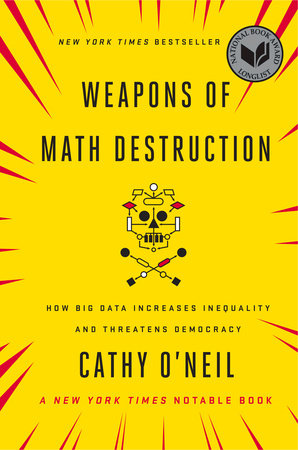
Weapons of Math Destruction (2016)

If you enjoyed Freakonomics, I think you’ll really enjoy Weapons of Math Destruction by Cathy O’Neil. This book is crucial as we become an increasingly data-driven, automated world.

http://images.randomhouse.com/cover/9780553418811?width=450&alt=no_cover_b4b.gif
Weapons of Math Destruction: How big data increases inequality and threatens democracy

While it’s very exciting that we have machine learning and big data, O’Neil highlights how important it is to realize that the algorithms that we allow to run our lives in an attempt to avoid human biases are, in fact, developed by biased humans. Or they run in a biased context. And it’s important to think about this, especially in the wake of things like social media algorithms that keep us in echo chambers of people repeating shared opinions back at us and with more and more tasks becoming automated to the point where we don’t know why things happen anymore – we can only point to the computers and say “the algorithm did it”. Although the book came out before the 2016 US presidential election, she touches on the danger of our News Feeds and the fake news that can circulate in these echo chambers, which has become a huge topic of late. She also touches on how Weapons of Math Destruction were involved with the 2008 housing crisis, which was why she left the hedge fund she previously worked at.

O’Neil is not afraid to name names, either. She calls out specific companies that enable and encourage data-based biases, like police predictive software and teacher evaluations. This book really opens your eyes to the kinds of injustices that we are no longer able to say is the fault of people and, instead, just shrug and say, “Well, the numbers don’t lie.”

And it’s true, numbers don’t lie. But the thing with the Weapons of Math Destruction, which are carried out at a huge scale, is they often don’t receive feedback as to whether or not they’re working. Unlike sports statistics, which O’Neil thinks is an ideal use of data because they are constantly calibrated based on whether or not the predictions were correct, these WMDs plow forward with no regard to whether or not the predictions are correct. This is all the more dangerous if they are written with biases in them or designed as self-fulfilling prophecies.

This was one of my favorite reads this year because I am fascinated but apprehensive about the role that big data is taking in our world. While I was busy worrying about what companies can do with my data (still a valid concern!), it’s so important to understand the the lack of transparency with how some of these big data predictions and decisions are made have very serious consequences.

I highly highly recommend you pick up this book and learn about how companies are using data to perpetuate biases and to learn ways that we can start critically thinking of solutions to avoid just that.


Disclosure: I received a copy of this book from Blogging for Books in exchange for my honest review.
The Snow Queen

Hans Christian Andersen’s classic fairy tales are well-known to many of us for their place in our collective fairy tale storybook and for their Disney adaptations.

Yes, The Snow Queen is the story that inspired Disney’s Frozen. But I’m not going to talk about Frozen. I want to talk about this gorgeous print edition of this classic winter fairy tale.

20161013_221251-01.jpeg

What a lovely way to share this classic fairy tale. If you only know the “Let It Go” version of this story, then I recommend visiting the original Hans Christian Andersen tale of Kay and Gerda and the Snow Queen.

The illustrations by Sanna Annukka are really beautiful.

If you have a friend who is a fan of fairy tales, illustrated books, or Hans Christian Andersen, or are looking for a classic book to read with a child in your life, I’d recommend this one and the others in this series.

(Ironically enough, yesterday was almost 80 degrees outside. But the winter will be here before we know it…)

In the middle of the vast, empty hall of snow was a frozen lake. It was cracked into a thousand pieces, but each piece was shaped so exactly like the others that it seemed a work of wonderful craftsmanship…


Back cover excerpt

Disclosure: I received a copy of this book from Blogging for Books in exchange for my honest review.

Life on the Edge (2015)

I am working my way through Life on the Edge: The Coming of Age of Quantum Biology, and although I’m not quite done yet, I just have to pause and talk about it with you.

24040194

What is life? And, maybe more importantly, why and how exactly is life? This is the huge question that McFadden and Al-Khalili aim to start answering in this book about quantum biology, which is the key to unlocking why and how life exists. They start with the example of the robin – as featured on the cover – that is able to use magnetoreception to navigate our vast planet, and take us on a journey through science history, from classical physics (Newton and his apple) to the birth of the field of quantum physics to the present day.

Read More »

Women in Science (2016)

I am a woman.
I am in science.

DSC01485

But you don’t have to be either to appreciate the women who have contributed to our collective body of scientific knowledge! And in fact, it’s important to take time to appreciate them because their work has frequently been trivialized or overshadowed by their male colleagues. I am grateful that we are finally able to give at least some women the recognition for their work.

DSC01486

For example, I’m really thrilled about the new trailer for Hidden Figures (definitely watch this!), which focuses on the black women whose work allowed an American astronaut to complete an orbit around the Earth. Women in Science has a feature on Katherine Johnson (who will be portrayed by Academy nominee Taraji P. Henson) if you’re interested in her story in advance of seeing the film!

DSC01500

I also liked how informative the book was about science as a whole field. Not only does the author and illustrator talk about each woman and her role in shaping our knowledge of science, but she talks about science itself. You can look at a timeline of events…Read More »