The World’s Tallest + Longest Glass Bridge (Zhangjiajie)

About a year ago, I started seeing videos and articles on Facebook about how there was going to be a new tourist attraction built at Zhangjiajie, amidst the mountains that inspired the scenes of Pandora in Avatar. In August, the longest and tallest glass-bottomed bridge in the world opened to visitors. I definitely did not think this was something I’d ever do. I visited Zhangjiajie several years ago, and it was really beautiful but quite a strenuous hike. China has been building a lot of attractions for the sole purpose of attracting tourists, and I didn’t want to positively reinforce that cycle.
Yet there I was, putting little shoe covers on over my feet and looking at the to scale diorama of the bridge and the canyon below it.
dsc02740
Here’s my experience with the record-setting glass bridge in Zhangjiajie.
Planning ahead would be best when it comes to visiting this Facebook-famous attraction.
  • You can reserve tickets online a day in advance, and this is, I believe, the best deal you can get on the tickets. We got ours from a tour agency on the way up, and they sell tickets at the door at the highest mark-up.
  • While the mountains are always a little misty, and the pollution is difficult to escape, the view on the bridge is more impressive on a clear and sunny day. We got clouds, so maybe that’s why I didn’t feel as much vertigo.
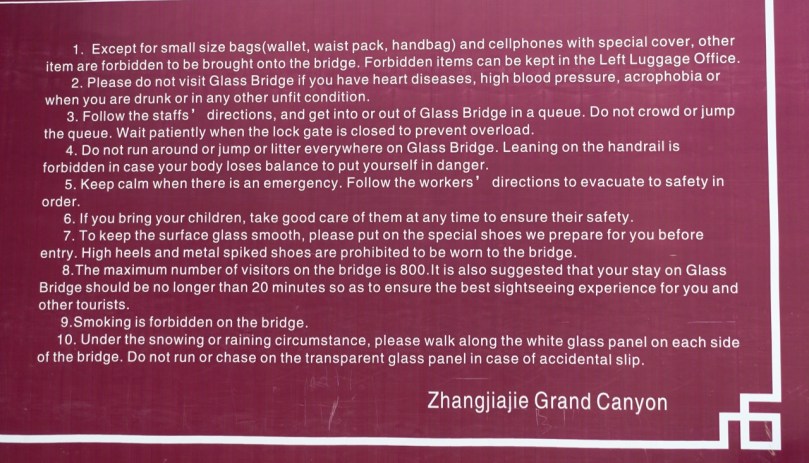
  • If you have a large bag (larger than a purse), you will be asked to check it – for a fee – at the concierge at the front.
  • You cannot bring your large camera in and will have to check that as well.  You can, of course, bring in your phone. I had my little camera in my pocket and had no issues with bringing it onto the bridge, but there were zero folks with larger cameras like DSLRs out on the bridge; I was the only person using not my phone camera to take photos.
  • Food is also prohibited on the bridge.There are a lot of little stands that sell food, so leave yours behind as they don’t want to attract too many critters onto the glass!
  • Don’t wear stilettos. You will not be allowed to wear them onto the bridge, as Force = Pressure / Area and the tiny area of your heel is very dangerous.
dsc02739
The English portion of the rules on the bridge
Once you arrive in the visitor center, you will receive a pair of shoe covers to keep the glass flooring dirt-free. They are mandatory, so don’t worry about getting that #shoefie or #selfeet (??) photo on the glass – you will be wearing those stylish covers on your feet. Just make sure you wear comfortable shoes if you choose to hike (more on the canyon hike below).
dsc02760
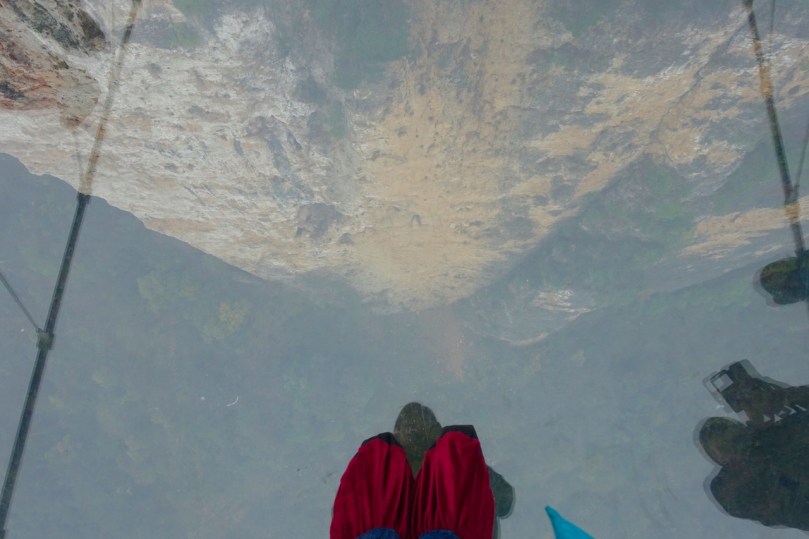
Mine were a wine red but I’ve seen a lot of different colors online! And yeah, that’s a pretty steep drop…
The glass bridge in Zhangjiajie spans the Grand Canyon, not to be confused with the famous canyon of the same name in Arizona. It measures ‎430 meters (1410 feet) long, ‎6 meters (20 feet) wide, and ‎300 meters (984 feet) high, making it the world’s longest and tallest glass-bottomed bridge in the world as of now.
DSC02743 (1).jpg
In the front is the pane of shattered glass, upon which several tons are resting to demonstrate the structural integrity of the bridge and each pane that makes it

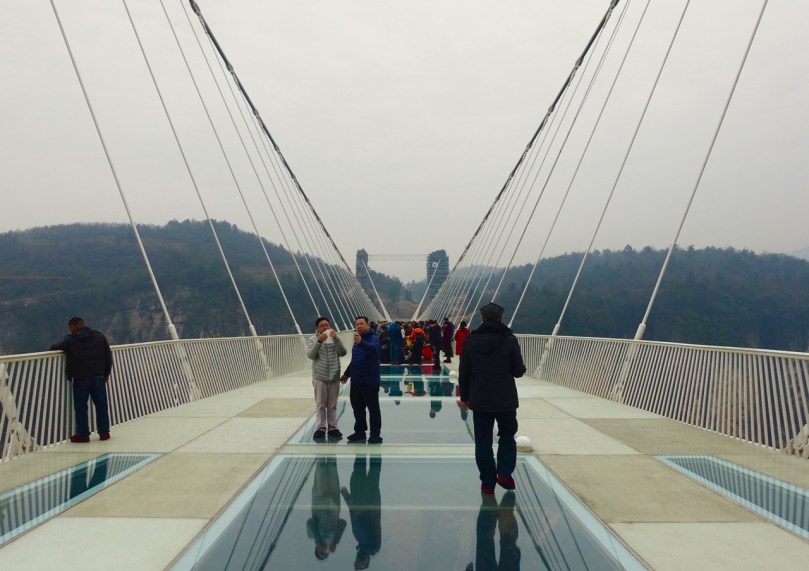
Stepping out on the bridge, you get the briefest sense of vertigo. I think that because we came on a rather overcast day, it wasn’t as bad because you didn’t have as clear of a view of the bottom of the canyon. The glass starts on the cliff, so you aren’t immediately stepping over a 1000-foot drop. Rather, you start on the rocks of the cliff, right beneath your feet, walk on some treetops, and then before you know it, the glass is only separating you from the earth and water hundreds of meters away.
dsc02753

There is a limit as to how many people are allowed on the bridge at any given time, and most of them congregate near the beginning of the bridge. Construction is not yet complete on the other side, so as of now, the front is the entrance and the exit; there is no through traffic on the bridge just yet.
dsc02746

At some point, they are planning on setting up the bridge for ziplining and bungee jumping, which I think is insane but whatever gets people’s blood pumping! If you’re looking for a quieter kind of thrill, I think the views here are pretty dang good.

dsc02747
With or without pollution, there is always a mystical mist drifting through the mountains in Zhangjiajie…

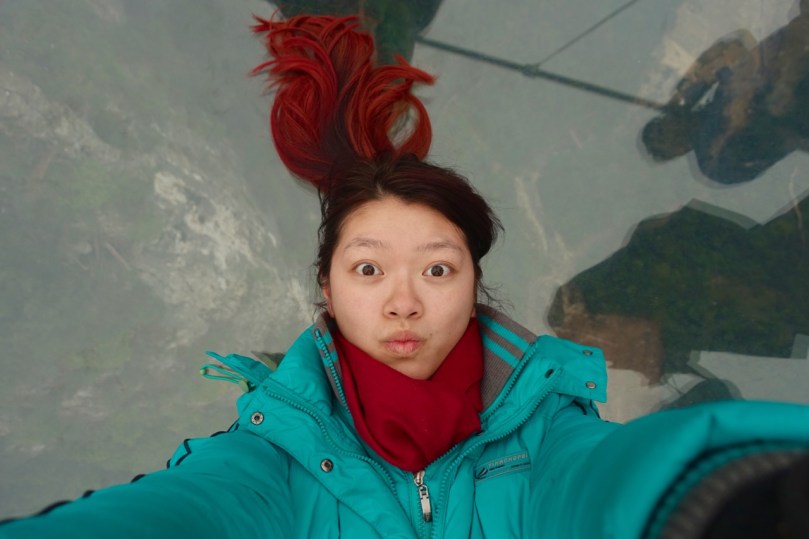
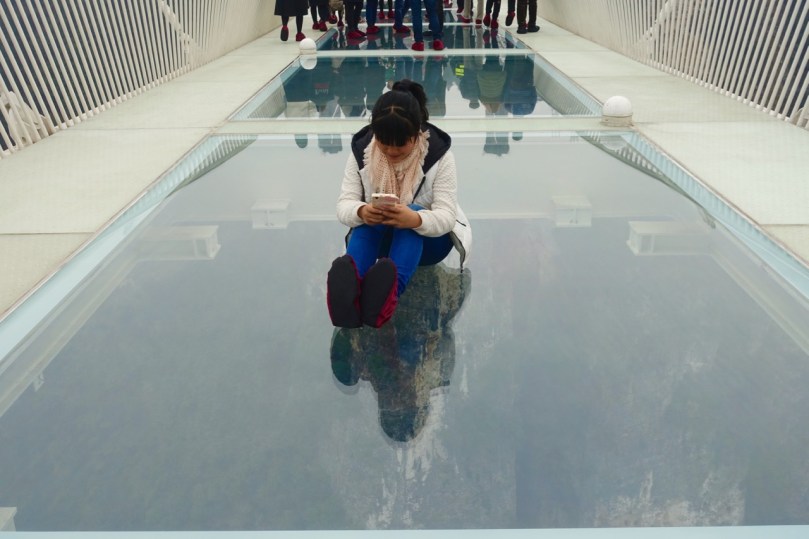
You’ll notice a lot of folks laying on the ground for their photos (like the selfie that was requested of me above) and trying to capture the drop below the glass. If you really want that to be clear, go on a clear day. The overcast day makes for moodier photos where you can only clearly see the drop below you in your shadow, as the reflection of the cloudy sky is very bright in the glass.
dsc02758
Here’s a shot of our teen tour guide, and you can see that her shadow shows the cliffs behind her most clearly

This was a lot of fun to visit in person, and so soon after I saw viral videos about this attraction online! I do wish we had sunnier weather, but with how bad the pollution has been in China, sunny clear skies are becoming increasingly rare.

Is it worth a visit? Maybe, once. It is super hyped in those videos, but honestly, the scariest thing was the dude stomping and galloping on the panes, causing the entire bridge the wobble. (Can you keep a secret? I would have only been a little distressed if someone pushed him off the bridge…) Also the hike through the Grand Canyon was terrifying but I’ll talk about that in the next one!


Would you visit this bridge? I would definitely recommend visiting Zhangjiajie in general, as it’s a gorgeous UNESCO World Heritage site with breath-taking views and mountains.
Have you ever walked on glass-bottomed bridges before?
I don’t know of any other ones, and this one just became very famous!

My 3 Must-Eat Meals in Changde

Following up on my must-eat meals in Beijing, where my mom’s family has been living for the past 30 years, it was only right that I tell you about the foods I needed to eat in my dad’s hometown of Changde 常德. Again, this does not encompass all of my favorite foods or Changde’s specialties, but here are the 3 foods I did not want to leave Changde without eating:

  1. Changde beef noodle soup
  2. 油粑粑 youbaba, a deep-fried doughnut
  3. Fish that I caught myself

1. Changde beef noodle soup

Changde is actually quite famous for their 牛肉米粉 niurou mifen, beef rice noodles. The noodles themselves are very distinct and difficult/impossible to recreate outside of Changde. (For similar reasons to why it’s difficult/impossible to recreate authentic NY-style pizza outside of New York – people attribute it to the water.) The noodles are the perfect consistency and absorb just enough flavor from the delicious soup without getting waterlogged. The soup is hearty and beefy without weighing you down and, in traditional Hunan style, it has a kick! (Hunan province, like Sichuan, is famous for spicy food. The big difference is the lack of the peppercorns that numb your mouth and/or cause extreme pain!)

dsc02736

This is officially my brother’s favorite breakfast food of all time, despite the fact that he usually tends to prefer more Western cuisines. We ate these noodles almost every single morning for breakfast with a splash of vinegar and relished these big bowls of soup and noodles and beef every single day we were with our family in Changde.

If you visit Changde, you must get a bowl. It is the most famous food out of Changde and one of the famous foods out of Hunan province.

2. 油粑粑

There is no direct English translation for this, but you baba roughly comes out to oil cake. If you are familiar with 油条 youtiao, fried crullers, then 油粑粑 will be a familiar food. It is a deep-fried ring with scallion bits throughout the dough and definitely not a health food. I also don’t see these in Beijing, and, as I understand it, this class of fried pastry is fairly unique to Hunan. I like these savory ones that are crispy and fluffy for eating on their own or dipping into my beef noodle soup.

dsc02737

They also make sweet 粑粑 varieties, and I would frequently hear street vendors with speakers advertising these while seeing kids running after them. It’s one of those foods that is really simple that just remind me of being in my dad’s hometown, eating breakfast with my family, who would tell me to not eat so much fried food…

3. Fish I caught myself

Since my grandmother’s passing, I always stay with my aunt and uncle when we visit Changde. My uncle is super passionate about fishing. He goes nearly every day, and whenever I show up at his place, there is fish that he caught on the table. The last time I visited China, he was drying scores of little fish for us to munch on as soon as we got in from the airport!

My grandfather also used to really love fishing, so every time we visit Changde, my uncle will take us to his spot to try our luck with the lines. I have come to enjoy how meditative fishing is, even though the weather wasn’t great the morning we went. It’s relaxing to sit and wait and slow down, which is really difficult for me and my racing thoughts to do.

dsc02677

Unfortunately, I did not catch a fish this time around. I almost got one but it got away. 😢 My brother caught a fish and my uncle caught enough to make up for it, and we were still able to come home with freshly-caught fish for dinner. It always tastes a little better knowing that you had to sit and wait and be rewarded for your patience. (And, in my uncle’s case, his skill!)


The food in Changde is really good and very different from the food in Beijing. Hunan is considered a southern province while Beijing is in the north. While it sometimes takes a bit of adjusting after eating a lot of northern-style food, I always have a great time eating when I visit my dad’s side of the family and the foods above are a big part of that.

Again, I cannot stress how grateful I am to have such amazing family that feeds me so much delicious food, whether they make it themselves, bring it home for me, to take me out to eat it. And I feel so fortunate that this amazing cuisine is part of my heritage. Eating is a big way that Chinese people connect, and it is instrumental in helping me reconnect with family members I haven’t seen in years. Nothing bridges the awkward gap created by time quite like sharing a delicious meal.

Have you ever been to Hunan before? If so, what are some of your favorite foods from the region?
What regional foods do you love, for China or elsewhere?
Hunan and Changde are known for their own variety of stinky tofu, but I just cannot bring myself to eat it, I’m sorry! It smells too stinky! (And I know, I know, the smellier the tastier, but I just can’t eat it after smelling it.) Frogs’ legs is also a dish I always see when I come back to Changde, and I refused to eat them for about 15 yeares after I rescued a frog to keep as a pet! I’ve had to acclimate over several years to the spice levels in the food in Changde, but it’s so worth it.

My 3 Must-Eat Meals in Beijing

After seeing my family (almost all of whom live in China save one branch of our family tree), the best thing about visiting China is the food.

The food game in China is next level. It’s not just about the quality and authenticity, but there are ingredients and entire cuisines that you can’t find in the US. Good luck trying to have homemade frogs legs and haw juice over here.

In Beijing, I had 3 must-eat foods that I didn’t want to leave without:

  1. Peking duck
  2. Hot pot
  3. KFC’s 老北京鸡卷 (or “Dragon Twister”, apparently)

Lemme explain.

1. Peking duck

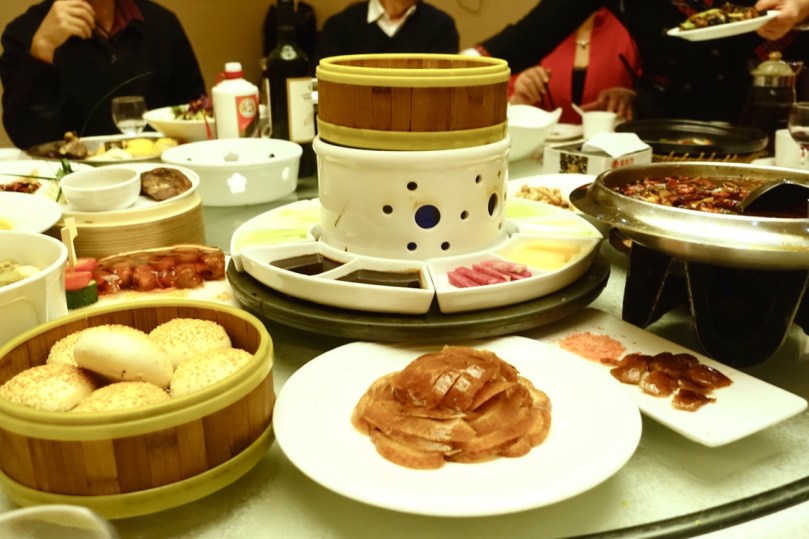
Peking duck is a meal I can’t avoid when in Beijing, aka Peking, and I wouldn’t dream of it anyway. I used to be obsessed with Peking duck, to the point where I ate too much too fast in one evening and stopped eating it for a long time. The crispy duck skin, the succulent meat, the sweet bean or hoisin sauce, the fresh cucumber and scallion, all wrapped up in a thin little pancake. It’s one of my favorite meals back home, and there are a lot of restaurants that do it well here in the US. (In fact, I had Peking duck for my 24th birthday dinner.)

dsc02516
Christmas dinner, a few hours after I landed in Beijing

But Beijing takes it to that next level, because it is the birthplace of this famous dish. First of all, the history of the dish in this city is extensive. There are several restaurants that have been around for hundreds of years and are household names for Peking duck. Second of all, Beijing hasn’t let tradition keep them from mixing things up, and during my 2014 visit to China, I learned that the toppings game for Peking duck has been elevated. In addition to scallions (mandatory) and cucumber slivers (optional but so common that they’re mandatory for me personally), you can expect to find additional toppings like cantalope melon, rhubarb, mango, and pop rocks.

dsc02579

Pop rocks! This was a thing I discovered a few years ago but the novelty hasn’t worn off for me just yet. The crispy duck skin is served separately from the meat, and you have the option of dipping the skin into pop rocks for a really fun textural party in your mouth. Some of the more traditional restaurants won’t have pop rocks but will have sugar for you to dip the duck skin. Some places have both, like above. (The green thing next to the cucumber is green pop rocks. Pop rocks!!)

Also, Beijing knows that if you have Peking duck, duck-shaped dinnerware makes 100% sense. I don’t know why US restaurants don’t really serve duck on little duck-shaped platters but it’s super logical and I am a little put out that I can’t have duck on a duck-shaped plate in America.

2. Hot pot

Hot pot is one of my all-time favorite meals anywhere. I love doing hot pot at home, because it’s so warming, you control how your food is cooked because you cook it yourself, you control the flavors with your dipping sauce, it’s a communal experience with everyone around a table. I always eat it the northern/Beijing way, and of course, Beijing is the perfect place to return for that.

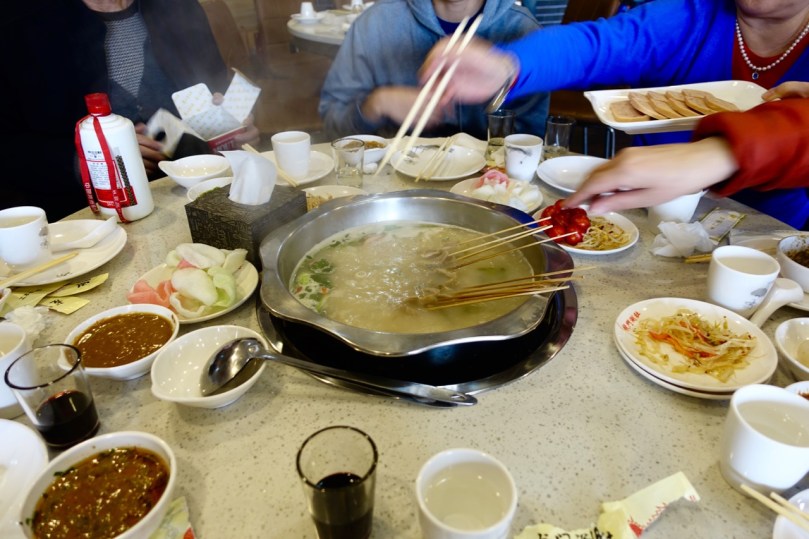
dsc02519

I’ve been meaning to write up a post about how I like to do hot pot, but Beijing has a ton of hot pot restaurants in many different styles. Above is lunch, less than 24 hours after I landed, and they had all of my favorite condiments for making my dipping sauce, these intestine skewers, and prawn chips which I think are brilliant and will try to include in my home meals from now on! (That crunch!) Hot pot warms you from the inside out, especially if you eat mutton, which is considered to be a “heating” food according to Chinese medicine. Make sure to order a LOT of veggies!

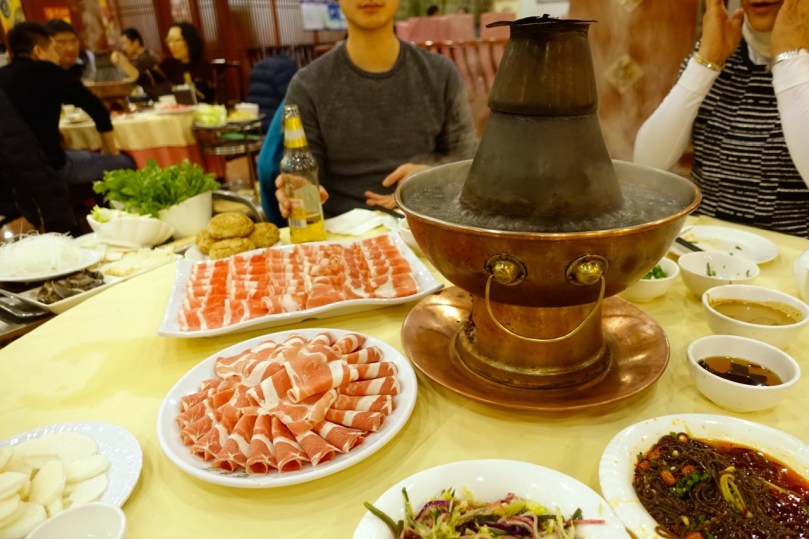
dsc02896

Hot pot is one of those meals with a fairly famous story behind it. Kublai Khan was preparing for battle and, in his hunger, demanded meat, but the hunters were unable to find anything besides a herd of sheep. They brought back lambs and the chef started preparing when Kublai Khan stormed into the kitchen and demanded to know why he was still not eating. He saw that the meat was already sliced and threw it into boiling water, cooking the super-thin slices almost instantly. The meat was served to him with just a little bit of seasoning, he went on to win his battle, and he requested that his chefs prepare lamb for him this way in the future. Above, you can see the traditional way to do hot pot in a traditional steamboat, which isn’t my favorite because the thin slices of meat occasionally stick to the metal in the middle.

3. KFC (… in China)

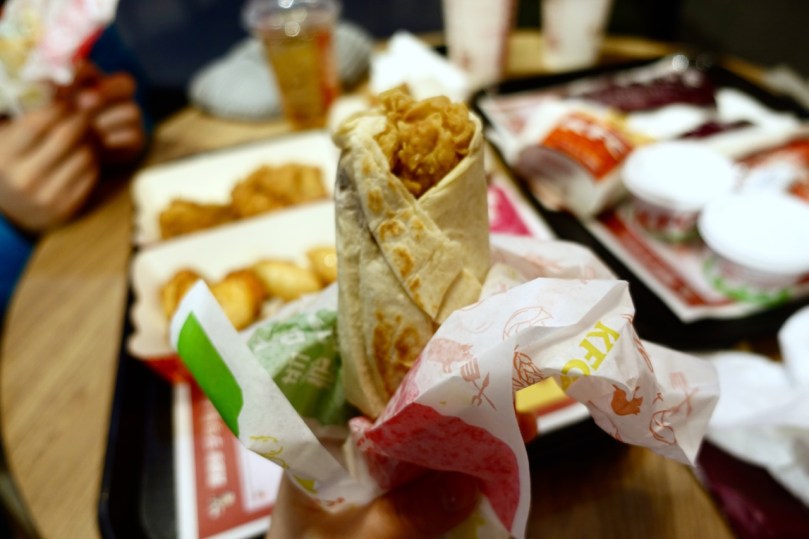
KFC may be cause for a few raised eyebrows, so let me explain. A few years ago, my cousin took me to a KFC and ordered me the 老北京鸡卷 (laobeijing jijuan, or Old Beijing chicken wrap) and I absolutely loved it. It is Peking duck – pancake, sauce, scallions – but instead of roast duck you have fried chicken. I was eagerly looking forward to eating it during my last trip to China, and was told I’d get to have it.

But I didn’t. And that disappointment had been sitting in the pit of my stomach for over 2 years. I knew that when I finally got to eat it, it wouldn’t be as good as the hype that was building but I couldn’t help it. Fried chicken AND Peking duck?

I told my family during our first Peking duck meal that I wanted to get my KFC this time and I was gonna do it, dangnabit! And get it I did, thanks for my wonderful aunts who were all too happy to oblige my weird American-ness.

dsc02646

We went to the first KFC that was opened in China, which was in fact the first Western fast food restaurant to open in China. To be honest, I don’t eat KFC in America, but I love KFC in China. I love that they were the first ones there, I love how they’ve adapted the menu to cater to local tastes with dishes like the Dragon Twister (I honestly had no idea it was supposedly called that). Once my dad came back with breakfast a few years back and said he got it from KFC. I thought that was excessive and weird and opened my eyes to see traditional Chinese breakfast foods that I know and love!

And I finally got my chicken wrap. And yes, it wasn’t that mind-blowing, partly because it seemed to have been sitting for a little bit and wasn’t very fresh. But I still think it’s a beautiful thing, to take all the fun of Peking duck and then throw fried chicken in there.

dsc02643


I ate so much good food in Beijing, and had a lot of great dining experiences. But when I was in the air, I wanted to make sure I ate these 3 things before I flew back home.

I’m very grateful to my family for making this happen for me, and for spoiling me silly by feeding me so much wonderful, delicious food.

What are some of your can’t-leave-without-eating-this foods and meals?
Do you have any for China?
Previously, I had 拔丝地瓜 (basidigua, yams covered in caramel that pulls away from the plate when you try to eat it) on my must-eat list but I think it’s getting too messy for me to enjoy as much as I did when I was a lot younger. However, I still have yet to see anywhere in America offer it on their menu, while it’s still hugely popular in China and I did get to eat it when I went back this time!

Street of Eternal Happiness (2016)

What do you think about when you think of China? One of the oldest civilizations, China today is full of contradictions. It’s a world power that is still ruled by the Communist Party while seeing incredible wealth and even more incredible poverty. You hear about Chinese tourists bringing shame to a nation of one billion people, remember the incredible displays of sheer manpower during the Olympics, and raise an eyebrow regarding most news stories that come out of the Middle Kingdom.

I have a lot of feelings when I think about China, because it does seem to be in a huge transition, and has been since the Communist Party took over. What I feel even weirder about is the fact that much of what I have learned about China’s modern history has been not from my family who lived through it but from white outsiders like reporters and historians, or through my (white) teachers at school. I didn’t know about the  Cultural Revolution until high school, and it occurred to me that my grandparents were probably reeducated. (They were.) It’s not something that would just come up in casual conversation with my family. Can you imagine a conversation going:

Hey Dad, was grandpa reeducated in the countryside because he was a judge?
Yes, and most of the friends he made died of starvation, along with millions of other Chinese.
Oh. And did you really kill sparrows during the Great Famine?
Yes, all of us children would pile the bodies of the birds. It wasn’t until later that we learned that eliminating sparrows was allowing worse vermin to destroy crops and worsen the famine.

Not really a conversation that just comes up. But I always wondered about how China became what it is today. What’s the context for all of the growth and suffering that occurs in China today? What is the context for everything I see when I go back to visit my family?

Read More »

Things You See More of in China

I made little notes about things that I noticed you see a lot of in China but you don’t really see in America. Here’s a little list I had been jotting down during my trip:

  • Kites
  • Fireworks/firecrackers

  • Good luck symbols
  • Tea
    • Loose leaf tea
    • Tea pots

      Chinese-Tea-Sets-6.jpg (800×533)
      Haha wait I think I own this set XD
  • Private room dining
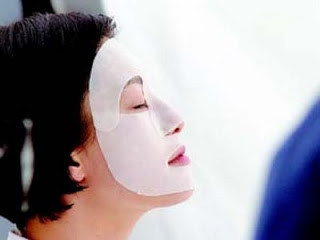
  • Sheet masks
  • Knee-length puffer coats
  • Tissues in bags (vs. in boxes)
  • Oranges

    They’re good luck!
  • People who are more afraid of being cold than of looking stylish
  • Incense
  • Overly cute accessories

    They don’t do anything, really, for pollution but they add a little extra something to your outfit.

These are the ones I have for now, but there are loads more. I left out so really obvious ones, trying to find little things.

What are some differences you have noticed between America and China?
Do you wish any of these were seen more in America?