10 Lies Depression Tells You

Originally posted by Anne Thériault on Thought Catalog.

I felt this was so crucial to share. There are too many days that I spend thinking that most or all of these statements are true.

This is important. It is important that you, and I, and anyone we care about know: None of these are true.

1. You are a bad person who deserves bad things.

2. You are unhappy because you are lazy or lacking in willpower. Happiness is a choice, a choice that you have failed to make. Somehow, somewhere over the course of your lifetime, when faced with some metaphysical fork in the road, you chose the wrong path. You brought this curse down on yourself.

3. Your sadness is the baseline by which the rest of your life should be measured. This sadness is your norm, and any other emotions, especially positive ones, are exceptions to the rule. Yes of course there will be good times, of course there will be flashes of joy; you will certainly, on occasion, experience the pleasure of a good book or a ripe juicy peach, However, those experiences will be few and far between. Your bad days will always outnumber the good.

4. Your family and friends do not love you. Your family are people who feel obligated to spend time with you because as luck would have it you share a similar genetic makeup. Your friends are people that you somehow tricked into thinking that you, as a person, have some kind of value, and now they don’t know how to extricate themselves from your pathetic, needy grasp. No one spends time with you because they enjoy it; they do it out of a sense of duty, a feeling of pity. Whenever you leave a room everyone breathes a sigh of relief.

5. Your family and friends do not want to hear about how sad you are. No matter how sympathetic they may seem, no matter how sincerely they might ask how you are feeling, remember that it’s all an act. The more that you open yourself up to them, the more you pour your heart out, the more resentful of you they become. Do not fall into the trap of sharing your feelings; do not give into the temptation to draw back the curtain and, like a tawdry magician, reveal your grotesque sadness. Your sadness is a choice, remember? This burden is yours to bear alone.

6. Your friends and family deserve better than you. Everyone deserves better than you.

7. In order to make up for your unhappiness, it is your responsibility to make sure that everyone around you is happy. If you can manage to maintain a near-constant veneer of kindness, helpfulness and sincere interest in others, then that will make your presence more tolerable. Your amiability, though entirely inadequate, is the best apology that you can make for your existence.

8. Everything is your fault.

If you plan a picnic and it rains, it’s your fault. You should have been more thorough when you checked the weather. You should have learned to be an amateur meteorologist so that you could better read the clouds. You should have packed a canopy. If you go out for dinner, for your once-in-a-blue-moon, hire-a-babysitter-and-wear-a-nice-dress date and the food or service or conversation is anything less than exceptional, it’s your fault. You should have read more restaurant reviews, should have asked friends for more recommendations, should have prepared cue cards with talking points. If someone is unkind to you, it’s your fault. You should have smiled more, been more gracious, tried harder to be whatever it was that they needed in that moment.

Everything is your fault.

9. There is no cure for your sadness, no effective treatment, no way of managing your symptoms. There are, of course, doctors and pills and various therapies that help other people, but you’ve tried all these things and they don’t work for you. Nothing will ever work for you.

10. You will feel this way forever.

If you are depressed, experiencing suicidal thoughts or otherwise need someone to talk to, please call 1-800-273-8255.

Soondubu Jjigae (순두부 찌개) [recipe only]

(The other post got wordy. Here is a clean version of the recipe that may actually be useful for cooking.)

Soondubu Jjigae (순두부 찌개)

Thanks to Maangchi (excellent Korean recipe site that also goes in depth on the specific ingredients) and EatYourKimchi (Canadian expat who makes fun videos about living in Korea) for their recipes, which I adapted and Frankenstein-cobbled together to make something that worked for me.

Ingredients

Note: Asian cuisine is about adjusting things to how you like it, so you are free to use more or less of things, as this is not a precise recipe and all quantities are simply what I used; I will likely never use these exact quantities in this exact combination ever again, and all measurements listed are approximations. Feel free to substitute

Stock (멸치육수) (you can also use pre-made seafood stock or beef, chicken, vegetable, etc.)

    • 12 dried anchovies (myulchi, 마른멸치)
    • 8-inch strip of kelp (dashima,다시마)
    • 1 medium onion (sliced/diced if you’d like)
    • 5 cloves of garlic
    • 6 dried shiitake mushrooms

Jjigae (stew)

  • 1 oz. fatty pork
  • 1-5 tbsp of hot pepper flakes (gochugaru, 고추가루)
  • 1 oz. kimchi + some kimchi juice
  • 1 cup of mixed seafood
  • Silken/soft tofu aka soondubu
  • Green onions aka scallions for garnishing
  • Sesame oil for serving
  • 1 egg for serving

Optional

  • Ddukbaegi (뚝배기) – black earthenware pot traditionally used for cooking and serving
  • Onion (sliced) for the stew
  • Zucchini (sliced) for the stew
  • Other seafood (clams, mussels, shrimp)
  • Soy sauce for flavor
  • Fish sauce for flavor
  • It’s a stew, add whatever you want, really.

Instructions

  1. Clean your anchovies by removing the intestines.
  2. Soak anchovies + kelp in water for about 20 minutes in ~2 cups of water
  3. While you are soaking your dry ocean ingredients, place your stock onion, whole garlic cloves, and dried mushrooms into a pot of ~4 cups of water.
  4. Boil, covered, for ~15 minutes
  5. Remove cover and reduce heat to allow the stock to reduce
  6. Add anchovy+kelp water to the pot of stock
  7. Boil, uncovered, until you’re happy with the stock (~10 minutes, do not overcook).
  8. Skim off icky foam
  9. Strain out the liquid for the stock to use in your stew.
    1. Optional: Remove (and slice) mushrooms and/or onion to use in stew
  10. Heat your pot that you will be using for your jjigae
    1. Optional: Add vegetable oil to aid with sautéing
  11. Brown your pork
  12. Add your vegetables to soften (onion, zucchini, more garlic if you love garlic like me)
  13. Add kimchi + hot pepper flakes (gochugaru)
  14. Fry until you can smell the kimchi + gochugaru in the air
    1. Optional: Drool over the smell
  15. Pour in stock until your bowl is about 3/4 full (it should sizzle when you do)
  16. Add seafood mix and let the stew come up to a boil
  17. Add tofu and break it up in the pot
  18. Reduce to a stew consistency (this is not a soup so let it get nice and thick)
  19. Adjust flavor with gochugaru, soy sauce, fish sauce, etc. if needed
  20. Take off heat
  21. Drizzle sesame oil
  22. Garnish with chopped scallions
  23. Crack the egg into the stew
    1. Either scramble it in or cover the pot and let it poach whole

Serve while still bubbling with a bowl of steamed rice and your choice of banchan (반찬) or side dishes.

img_01441

Enjoy!

Soondubu Jjigae (순두부 찌개)

(For a clear, actually usable recipe, please click here.) (Because the recipe included in this blog post is, much like the cook, chaotic.)

I live in a town with an extremely prominent Korean community. This is a bit of a change from where I lived previously, which had the largest Indian demographic of any town in the US along with a sizable Chinese and Jewish community. Whereas I used to have 3 Chinese supermarkets within a 10-minute radius of my house previously, I now have 3 Korean supermarkets within that 10-minute radius.

So, 7 years of living here have resulted me not being able to speak very much Korean. BUT I am a stickler for pronunciation, so the little bit I know is pretty convincing, according to some sources. (Source: Very kind friends.)

I had my very first taste of soondubu jjigae (순두부 찌개), otherwise known as Korean soft tofu stew  and a variety of other romanizations (soondooboo, sundubu, soondoobu, etc.) just a few weeks ago. The weather on the Eastern seaboard had gotten quite noticeably colder and I decided to try it. This bubbling pot of spicy tofu stew with an egg and seafood sounded really promising.

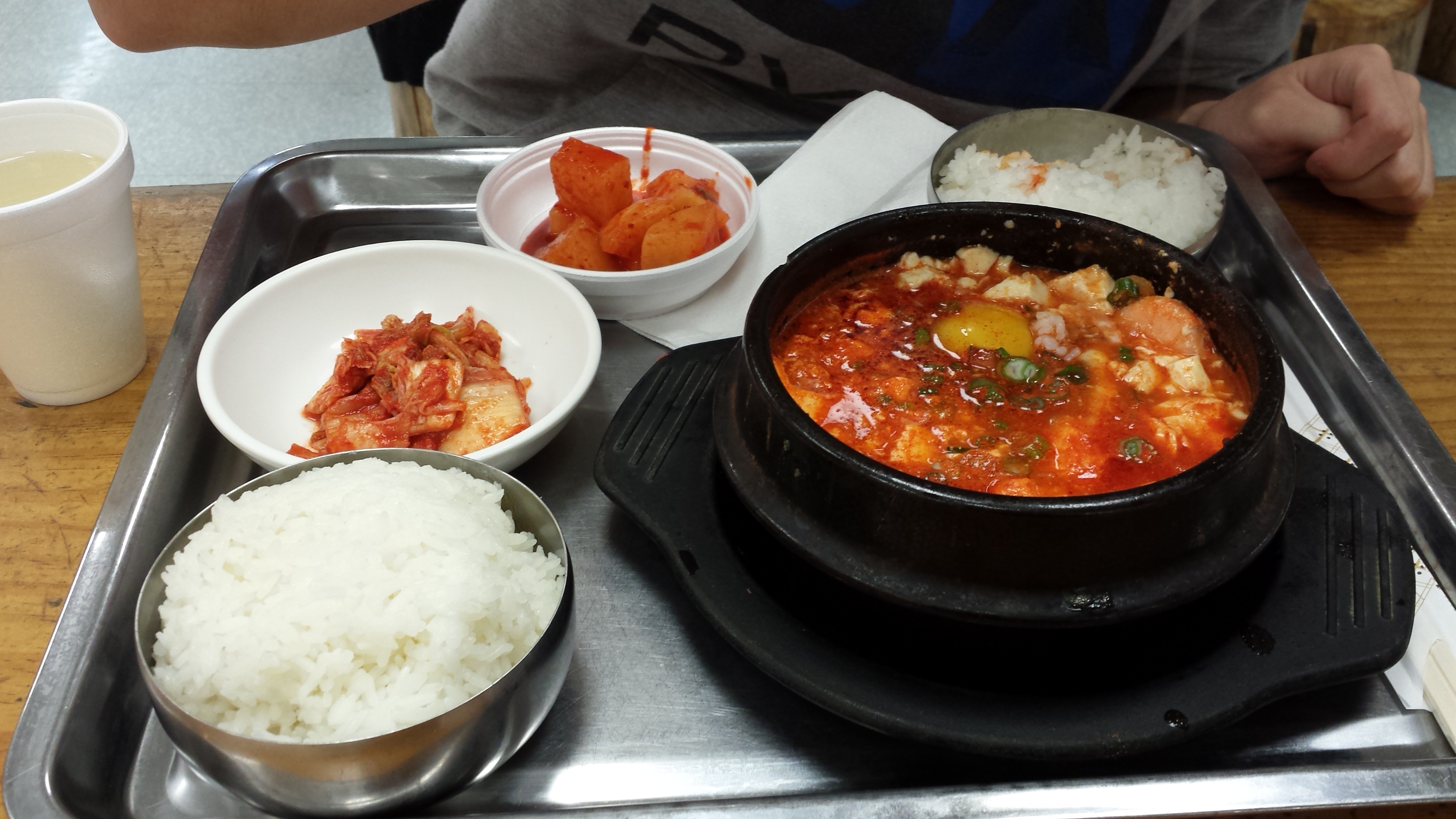
A bowl of soondubu jjigae, rice, banchan
My first soondubu jjigae ever! (Actually, it was my brother’s and I pilfered some.)
From: Manna Korean

Obviously, I never looked back since. I’ve had 3 soondubu jjigaes in the past month. That’s 3 more than I’ve ever had in my whole life previously.

My second soondubu jjigae (which was all mine!)
From: Gah Rahm Restaurant
My third soondubu jjigae, from a restaurant that specializes in soondubu jjigae!
From: Lighthouse Tofu

I was really determined to learn how to make this. This resulted in me going to a Korean supermarket on Saturday to buy the following things that I didn’t have in my house:

  • Ddukbaegi (뚝배기) aka “Dad I need to get one of those cool Korean black pots”
  • Myulchi (마른멸치) aka dried anchovies for an authentic-tasting stock
  • Dashima (다시마) aka kelp for an authentic-tasting stock
  • Gochugaru (고추가루) aka hot pepper flakes for spiciness (I later found out my dad had a secret store of this already what)

I used a few cheats and not-quite-right-but-it’ll-do substitutions to make do with what I had at home and not buy literally every ingredient from Lotte. Many thanks to Maangchi (excellent Korean recipe site that also goes in depth on the specific ingredients) and EatYourKimchi (Canadian expat who makes fun videos about living in Korea) for their recipes, which I adapted and Frankenstein-cobbled together to make something that worked for me.

Watch me struggle!

Here is a video I recorded while I was cooking to document the process. I edited out a lot of my struggle…

Without further ado…

Soondubu Jjigae (순두부 찌개)

Ingredients

(Note: Asian cuisine is about adjusting things to how you like it, so you are free to use more or less of things, as this is not a precise recipe and all quantities are simply what I used) (I will likely never use these exact quantities in this exact combination ever again)
(Because if you see “cups” or “tsps” or “oz” it’s seriously a complete guess I measured out nothing XD)

Stock (멸치육수) (it’s best to make the stock for the specific flavor, but you can also use pre-made seafood stock or beef, chicken, vegetable, etc.)

    • 12 dried anchovies (myulchi, 마른멸치)
      • Be sure to clean these by removing the intestines, or your broth will have a bitter flavor D:
    • 8-inch strip of kelp (dashima,다시마)
      • I think you’re supposed to use dried squares of these, but I used non-dried strips so… ??? I’d say maybe like 6 square inches?
    • 1/2 to 1 medium onion (sliced/diced if you’d like)
      • I sliced mine and used about 75% for the stock and reserved the other 25% for use in the stew
    • 5 cloves of garlic
    • 6 dried mushrooms
      • Officially, these should be dried shiitake, but I used something else oh well

Jjigae (stew)

  • 1 oz. pork (or protein of choice)
    • Fatty pork would be best here, e.g. samgyupsul, 삼겹살, but I only had lean pork so I may or may not have used a bit of bacon fat because it made sense in my head at the time…
  • 1-5 tbsp of hot pepper flakes (gochugaru, 고추가루)
    • This is one of the most easily adjustable parts of the recipe, as you are determining the spice level. It’s always best to start with less so you can add more later. I used one heaping Asian soup-spoonful (probably close to 2 tbsp)
  • 1 oz. kimchi + some kimchi juice
  • 1 cup of mixed seafood
    • You can buy cheap bags of frozen seafood mixes filled with things like mussels (out of shell), shrimp (peeled and deveined), calamari rings, etc. and thaw them while prepping your stock
  • Silken tofu aka soondubu
    • Since you add this towards the end, you’ll have to use your judgment for how much will even fit in your pot. Korean brands come in nice tubes, sometimes, but I used about 1/4 of a full square tub because I ran out room in my pot oops
  • Green onions aka scallions for garnishing
  • Sesame oil for serving
  • 1 egg for serving

Optional

  • Ddukbaegi (뚝배기) makes you feel cooler but is not necessary
  • Onion (sliced) for the stew
  • Zucchini (sliced) for the stew
  • Other seafood (clams, mussels, shrimp)
  • Soy sauce for flavor
  • Fish sauce for flavor
  • It’s a stew, add whatever you want, really.

Wow. Sorry about that… um… ANYWAY LET’S GET TO IT.

Instructions

These will be more straightforward since the ingredients list was such a mess.

  1. Clean your anchovies and get out the amount of kelp you want for the stock.
  2. Soak anchovies + kelp in water for about 20 minutes in ~2 cups of water
  3. While you are soaking your dry ocean ingredients, place your stock onion, whole garlic cloves, and dried mushrooms into a pot of ~4 cups of water.
  4. Boil, covered, for ~15 minutes
  5. Remove cover and reduce heat to allow the stock to reduce
  6. Add anchovy+kelp water to the pot of stock
  7. Boil, uncovered, until you’re happy with the stock (~10 minutes, do not overcook)
    1. Taste a little as you’re cooking to make sure you have maximum flavor without overcooking the anchovies into a yucky mess
  8. Skim off icky foam
  9. Strain out the liquid for the stock to use in your stew.
    1. Optional: Remove (and slice) mushrooms and/or onion to use in stew
  10. Heat your pot that you will be using for your jjigae
    1. Optional: With vegetable oil if your pork isn’t fatty enough
    2. Super optional: Bacon fat is what I used but… probably not the best XD
  11. Brown your pork
  12. Add your vegetables to soften (onion, zucchini, more garlic if you love garlic like me)
  13. Add kimchi + hot pepper flakes (gochugaru)
  14. Fry until you can smell the kimchi + gochugaru in the air
    1. Optional: Drool over the smell
  15. Pour in stock until your bowl is about 3/4 full
    1. Note: It will SIZZLE and that’s perfect! Don’t be scared 😀
  16. Add seafood mix and let the stew come up to a boil
  17. Add tofu and break it up in the pot
  18. Reduce to a stew consistency (this is not a soup so let it get nice and thick)
    1. At this point, you can adjust the flavor with more gochugaru, soy sauce, or fish sauce, or add more water/stock if the flavor is too strong
  19. Take off heat
  20. Drizzle sesame oil
  21. Garnish with chopped scallions
  22. Crack the egg into the stew
    1. Either scramble it in or cover the pot and let it poach whole

Serve while still bubbling with a bowl of steamed rice and your choice of banchan (반찬) or side dishes. I had some konjaban (콩자반) that I really wanted to dig into.

Enjoy! 😀

Update on NaNoWriMo

Unfortunately, I will be bowing out of NaNoWriMo this year. I haven’t really written since that first burst of writing during week 1. Usually, my characters and their motivations write themselves, but since I had zero planning, my characters didn’t have any motivations.

It’s hard to write like that.

I will be shelving my project for next November, doing a little bit of research and development in the meantime so that I’m ready to write 50,000 words next year. It is already on my resolutions blog. (Can you believe I’ve started drafting a resolutions post already? I have almost 30 drafts for blog posts, so… I need to get to publishing!)

Tallinn

After spending a day at sea, we arrived in the smallest and least-known country of our tour: Estonia.

VERY tourist-friendly, I highly recommend a visit!

Tallinn is a beautiful city. It is the oldest capital city in Northern Europe! I was told that Estonia was one of the later countries to end feudalism, and this was the explanation provided to me for many of the medieval-era architecture that still remains in the city.

The tower of the Toompea Castle, which, along with this pink Baroque-style building, now houses the Parliament Castle

Despite these omnipresent reminders of its medieval history, Estonia prides itself on its technological advances. Estonia has become a little Baltic Silicon Valley. Skype was invented here. (And they’ll never let you forget it!)

One of my favorite parts of my tour of Tallinn was visiting the Old Towne. You don’t have thousand-year-old structures in America, but in Tallinn, if you looked in the right place, you were transported back to the 1300s.

We also got to browse a little market here, where I almost bought a gorgeous Russian-style faux-fur hat but didn’t because that thing was 30€ say what. Lots of winter clothing being sold for the end of July… XD They were not so down with haggling, though. We did not expect the vendors to let us walk away but that’s exactly what happened.

I don’t have a LOT more to say about Tallinn, because our tour was shorter and it’s a smaller city. I didn’t have a lot of context for a lot of what I learned, and we spent a long time just wandering around as well. But I enjoyed my time there and took lots of really fun photos, so please enjoy 🙂

I saw this ad maybe 10 times. XD
Karen Gillan selling Lays chips.

“Linda”

I have plenty more photos but I’ll spare you for now. I would love to learn more about Tallinn and Estonia!